Ted Lasso: The manager you should aspire to be
If you want to be a good people manager, you could do a lot worse than using Ted Lasso as an example.

I’ve been lucky enough to have had some good managers in my career. Unfortunately, I think business land tends to under value what exactly makes a good manager … good. My wife and I just started a re-watch of Ted Lasso and as I was laying out the bullet points of what you’re about to read on our back patio, Clare said “Hey that’s your next blog!” So here we go.
Managing people is a different skill set
I’m sure you’ve heard some version of this before, but the typical way someone ends up being a manager is that they are a really great individual contributor and then one day, they get promoted. Suddenly, their job is no longer being a good {engineer, lawyer, designer, etc.}. Now the job is leading and coaching other people. We think of this change in role as a natural career trajectory. You do a thing and then you manage people doing a thing. It’s basically the same job, right?
Unfortunately a more apt analogy would be “you work as an accountant for a while, then you get promoted and suddenly you’re a physical therapist.” That’s a bit of an exaggeration, but not by much. The point is: It’s a different job, with different skills required, and we should treat it like that.
Before we go any further, let’s distinguish between what I would consider the two main buckets of “work” you’ll tend to find in most jobs: the job of deciding what to do and the job of deciding how a team should execute that work. For the former, I’m going to use the term “architect” mainly because that’s whats its called in the world of software development. The latter, I’m going to call coach.
The architect
The job of the architect is, as said before, deciding what a team should do. Here’s a few examples:
- For a software product, a software architect might determine “we need a REST API and a database and they should be connected in this way, etc.”
- In a hospital, a medical architect, probably someone like an attending physician (Clare and I have also been watching ER) might determine “here is the course of treatment this patient needs.”
- A literal architect (as in the building kind) decides what the layout of a house should be and what rooms should go where.
Notice that nowhere in the above did I mention anything about other people. Nothing about who is doing the work, or how many people, or what their individual roles might be. The architect is only concerned with the “what”. They are the subject matter expert on what needs to be done.
Ted Lasso: The purest coach
Alright, so what does Ted Lasso have to do with this? If you haven’t seen the show, go watch it. It’s refreshingly … what’s that feeling … happy? I don’t feel that very often in the year of our lord 2026 so forgive me for not remembering. Anyway, here’s the highlights: Jason Sudekis is a former college football coach in America who takes a job coaching a premier league soccer team in the UK. Shennanigans ensue, but spoilers: the team goes from a rag tag group of misfits to a functional and successful team under his leadership.
The relevant part for this discussion is how Ted facilitates that growth. Importantly, it has nothing to do with his expertise in soccer. After all, he has never played and overall knows nothing about it! Ted is the purest form of a coach.
The main tasks for a coach should be:
- Hire the right people.
- Help those people to perform their best at work, which includes making sure they have what they need as human beings.
- Ensure the those people are working as a cohesive team.
What do you know? That’s exactly what Ted focuses on in the show. Notice too, that those duties are pretty generic. They don’t have anything to do with software or sports or medicine. It’s about the team and how it functions.
What Ted gets right
Focus on the environment, not the sport
All of his actions and tactics are about creating the right personal and team dynamics so that everyone can perform well. Creating an empathetic and emotionally safe environment. Pushing people to connect with their team mates and understand them. Getting them all to believe winning is possible. Notice I didn’t use the word soccer there at at all. These are universal team principles. I could rephrase this section as “focus on the team, not the product” and it all still applies.
Stay in your lane
Ted knows he lacks knowledge in soccer tactics. So what does he do? Find someone who does! (Nate). Good coaches know what they don’t know and facilitate getting others in the right positions to succeed. They don’t make uninformed decisions because “they’re the manager”.
Alright, you probably can’t know nothing about the job
So let’s get back to reality a bit. Ted not knowing anything about soccer is too extreme of an example. A manager shouldn’t have zero expertise in the domain of their reports. But they don’t necessarily need to be the best at it, as long as we’re abiding by cardinal rule of “don’t tell your players what to do”.
Where we’ve gone wrong
The two roles I’ve described above to me at least feel like they naturally emerge from how any team based work gets done. Somewhere along the way though, we botched things.
A “manager” is typically both roles in one
I would venture to guess that in most companies, someone who is a manager is responsible for both coaching/development and the technical direction of the team. This has a few problems, chiefly that it’s actually quite rare to be good at both of those roles which inevitably means that one or both jobs will suffer.

I think you may be mistaken. The business cats at the shelter did both of those jobs.
Just from a practical standpoint also, you typically don’t start out managing people. So the first time someone is a people manager is typically when they’ve just been promoted and taken on more responsibility. The pressure is higher, they have less free time than before and oh, by the way, they have to do a totally different job. What could go wrong?
One of those roles is more important than the other
So the real problem is that organizations tend to promote people more for the people management side than the architect side. This leads to a bunch of management layers that progressively understand less and less about the what but still make the decisions about it. Also, because they’re so many levels removed from the work, they aren’t even really effective coaches anymore either.
The pipeline is broken
The two things above inevitably lead to the following structure
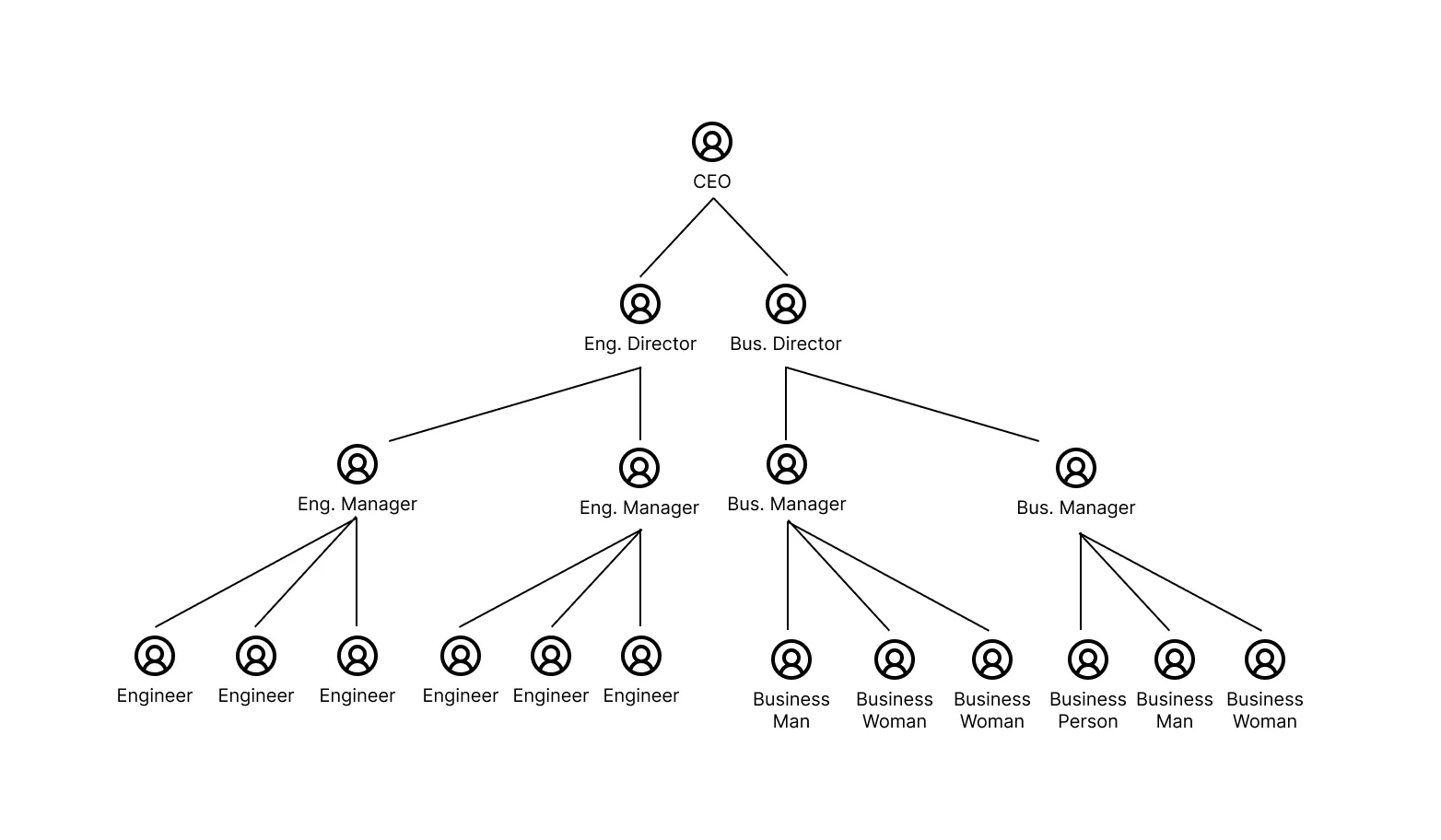
What’s the key problem here? Layers of people disconnected from doing the actual work and no one truly focused on what needs to be done.
Hot take alert
In a perfect world, if you quit tomorrow, your manager should be able to do your job. Maybe not quite as well, but well enough to get by at least for a while. Now, how many of you just thought: “there’s no way my boss could do my job”? Therein lies the problem. People who can’t actually do a thing evaluating, hiring, and firing people who can do the thing.
I can say that at least in a few cases, I’ve had managers who could absolutely step in and do my job if needed and I’m grateful for that. I would go so far as to say that this rule should apply to CEOs (though I imagine few would pass my test. I highly doubt Sundar Pichai could sit at a terminal and write any code. No wonder Google is a shit show now).
But isn’t that unreasonable to expect of one person Matt? To be able to do accounting, HR, engineering, design, etc..?
No. No it’s not. I bet there’s plenty of people out there who could do a passable job at all of those. And also, I think given how much these people are paid, it’s perfectly reasonable to expect a lot of them. Maybe it’s a problem that we don’t…
We have a bunch of people who are primarily focused on how to do things telling the organization what to do. This is the core of why organizations say they aren’t “agile” or “innovative.” There’s too many layers of managers and those managers don’t know enough about the subject matter to make good decisions. They mainly know about people management and managing people who manage other people.
A better way to build
Here’s my alternative proposal for an organization:
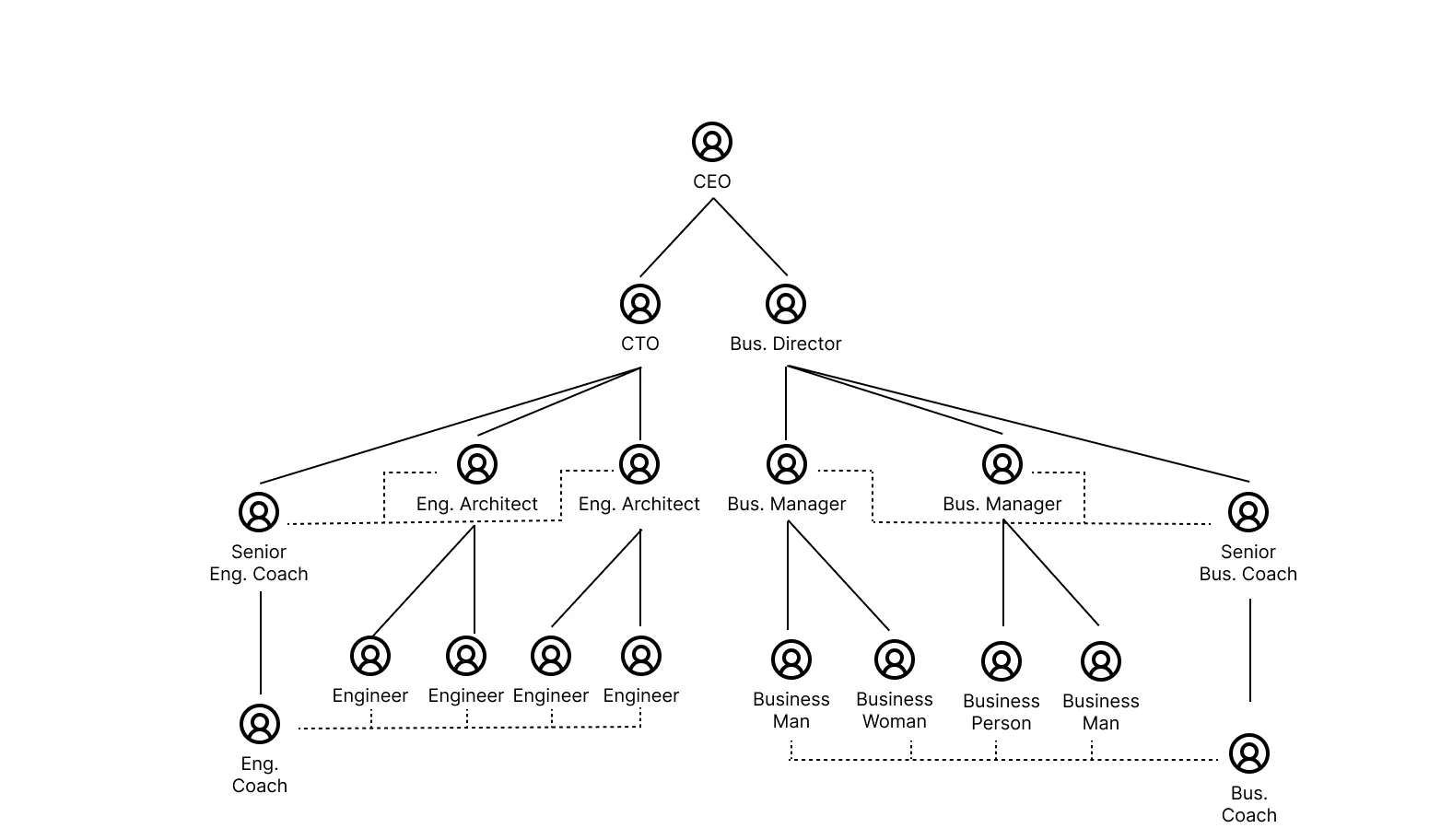
The really important part is the solid vs. dashed lines. Dashed lines mean you coach those people and solid lines means you tell those people what to do. Both important but very different skill sets.
Notice too that coaches are in charge of coaches and architects are in charge of architects. The people who do the thing are responsible for people below them who also do the same thing, whether thats coaching or execution. Both are important but are different paths someone might take.
Play to your strengths and know when to lean on your team
If it had to give one piece of advice to you reader, whether you’re a manager, a contributor or a cat, it’s this:
You don’t have to be the best at everything. Lean into your strengths and find people who you trust to fill in the gaps.